Church of Dulce Nombre de Jesús
History and architecture of the Church of Dulce Nombre de Jesús, the colonial church at the heart of faith in Petare.

In this article 3
The Church of Dulce Nombre de Jesús (Sweet Name of Jesus), in the heart of Petare, is one of the oldest and most representative churches in Venezuela. It has witnessed centuries of change and historic events that have shaped both the local community and the country's history.
In this article we explore the church's rich history, its architectural evolution and the heritage treasures it holds, highlighting its importance as a spiritual and cultural symbol of Petare.
History of the Church of Dulce Nombre de Jesús
The Church of Dulce Nombre de Jesús, regarded as Petare's main center of faith, has accompanied the community's spiritual life since its founding on 17 February 1621. That same day, Father Gabriel de Mendoza blessed the first foundations and marked out the boundaries of the graveyard behind it.
The building began as a humble hermitage, gradually becoming a chapel and later the majestic church we know today. These changes were made possible by the efforts of local authorities and the parish priests who served there over the years.
In 1630, the Franciscan friars of Caracas built a structure of wattle and daub and palm thatch, with a simple single-nave design. By 1754 it had been rebuilt with rammed-earth walls and tiles, although the main chapel was still unfinished and the tower, with two doors, had a wooden choir.
On 26 June 1798, a new extension was recorded in an inscription on the north wall celebrating the completion of the main chapel, built in rammed earth with a tiled roof. A two-room sacristy was also added.
During Bishop Mariano Martí's pastoral visit in 1772, the building was under repair, but twenty years later it was in such poor condition that it was feared it would collapse. In 1795, after an earthquake and accumulated rain damage, the sacristy roof caved in, leading the authorities to approve its reconstruction and enlargement.
The great earthquake of 1812 caused considerable damage, leading to further changes to the church. In 1830 the adjoining cemetery was removed, and in 1835 Father Jacinto Madelaine began adding a new level to the tower, a job completed by Friar José Maraury in 1858. By then the church already had three tiled naves. The clock was installed in 1861, and the engraving made by H. Neun in 1877 shows the exterior of the church as we know it today.
In the early 20th century the church was generally in good condition, except for a crack in the presbytery caused by the 1900 earthquake. Between 1925 and 1938 two chapels were added at the end of the side naves. In 1964 architect Graciano Gasparini led a restoration of the interior, during which mural paintings were discovered. However, the 1967 earthquake caused new damage, and the last major repairs were carried out in 1989.
Architectural features
The structure of the Church of Dulce Nombre de Jesús follows the design of the cathedrals of Coro and La Asunción, a model also repeated in the churches of Guanare, Barcelona, Turmero and San Carlos. Its dimensions are impressive: 43.50 meters long by 19.50 meters wide, with a tower 6 meters wide. The church has three naves, the central one being the most prominent, flanked by arcades resting on Tuscan columns. The side naves, known as the Gospel and Epistle sides, house the minor altars.

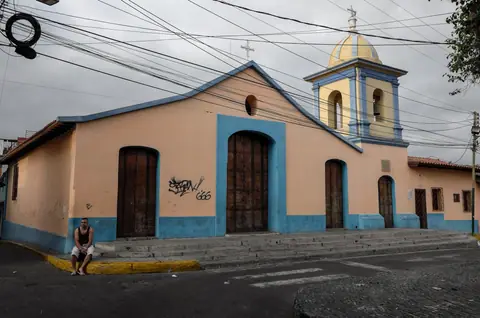
The main façade has three sections, each with pilasters framing the three entrances. The arches over the doors are segmental, and in the third section a small ogee window stands out in the pediment. The bell tower at the top holds three bells, a clock and a half-orange dome.
Valuable treasures
The Church of Dulce Nombre de Jesús holds a large number of remarkable objects, including altarpieces and carved wooden religious images, delicate silverwork and two impressive murals by master Tito Salas: El Nacimiento Azul (The Blue Nativity) and El Milagro del Cristo (The Miracle of Christ).
Altarpieces and images
The church's altarpieces have been preserved almost intact, an extraordinary feat, as few churches in Venezuela have been so lucky. The High Altarpiece, in Rococo style, was worked on by Canarian woodcarver Domingo Gutiérrez around 1763. This monumental piece has ten columns arranged in three sections. At its center is a relief of the Immaculate Conception, a niche with the figure of the Child Jesus, patron of Petare, and four paintings of the evangelists Luke, Mark, John and Matthew, painted by Alonso Aponte in 1764.
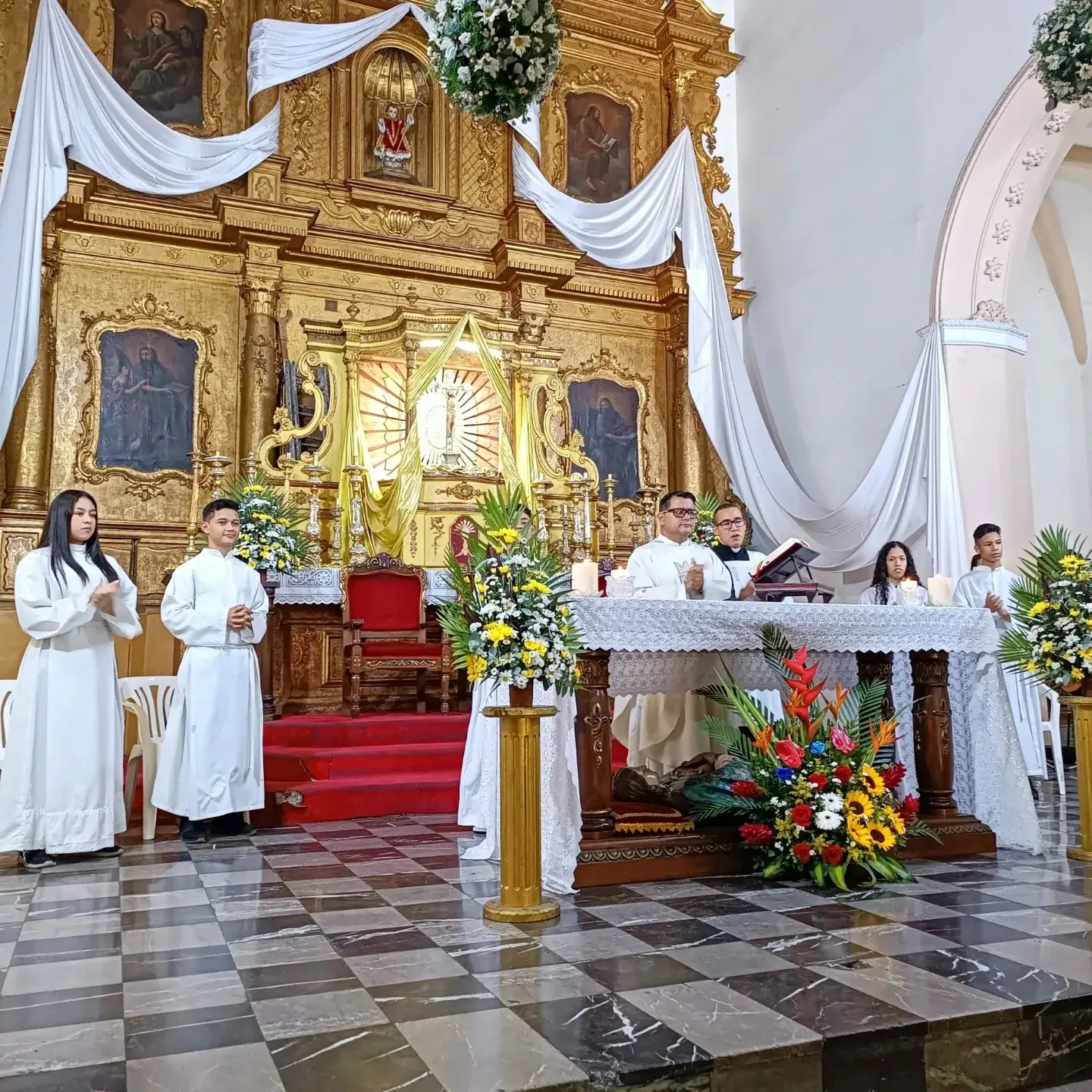
The six minor altarpieces, made after 1780, are arranged on both sides of the church, each with an image in its niche. On the Epistle side are the altarpieces of La Victoria, Jesus at the Column and Jesus in the Garden, while on the Gospel side are those of La Candelaria, El Carmen and El Nazareno. Decorated with gilded inlays and oil paintings, they were made by anonymous cabinetmakers, probably from Caracas. The La Candelaria and La Victoria altarpieces are Rococo, while the others are examples of Neoclassicism.
These altarpieces hold venerable images such as the Ecce Homo, Our Lady of Coromoto, the Virgin of the Rosary, Saint Jude Thaddeus and the Holy Trinity. Most of these sculptures date from the 18th century and are carved only in the face and hands, with simplified wooden bodies to make them easier to carry in processions. The fully carved figures include the Child Jesus, the Cristo de la Salud and the Ecce Homo. They are adorned with precious jewels, wigs of natural hair and rich garments, looked after by the town's most prominent families.
Silverwork
In the 18th century, Venezuelan silversmithing reached its peak, and one of its leading figures was Pedro Ignacio Ramos, who in 1779 made the Child Jesus's silver sash, adorned with pearls and emeralds. Later, Pedro Fermín Arias, influenced by Neoclassicism, made a solid gold halo for the holy child set with 55 emeralds. He also made the Processional Throne of the Child Jesus, a piece of chased and embossed silver topped with a crown.
In 1873, Bernardino Caballero contributed a monstrance of embossed and gilded silver, supported by angel figures and decorated with emeralds.
An anonymous artist made the patron saint's shoes in hammered silver, decorated with colored doublets. They are first mentioned in the church inventories of 1847. Among the more recent acquisitions are the gold rays (potencias) of the Cristo de la Salud, dated 1947.
Mural paintings
The church holds valuable mural paintings on the altar walls, the side doors and the upper edge of the walls. Known as Damask Curtains, these paintings were common in 17th-century homes and religious buildings. Two cherubs painted next to the La Candelaria altarpiece stand out in particular, made using the fresco technique, which is rare in Venezuela.